Open Science
Open science is a movement that promotes the principles of transparency, accessibility, and reproducibility in scientific research. It encourages researchers to share their data, methods, and findings openly with the scientific community and the public. By making research outputs freely available, open science aims to accelerate scientific discovery, foster collaboration, and enhance the credibility and impact of scientific research.
Open Research Data
Open research data refers to the practice of making research data freely available to others. This can include datasets, metadata, code, and other research outputs. By sharing research data openly, researchers can enable others to validate and reproduce their findings, as well as to build upon their work. Open research data can also facilitate data reuse, allowing other researchers to analyze and interpret the data in new ways, leading to new insights and discoveries.
Reproducibility
Reproducibility is a fundamental principle of scientific research that refers to the ability of others to replicate the results of a study using the same data and methods. Reproducibility is essential for ensuring the credibility and reliability of scientific findings, as it allows other researchers to verify and validate the results. By promoting reproducibility, scientists can build trust in their research and contribute to the advancement of knowledge in their field.
The Role of Temporal Queries in Open Science and Reproducibility
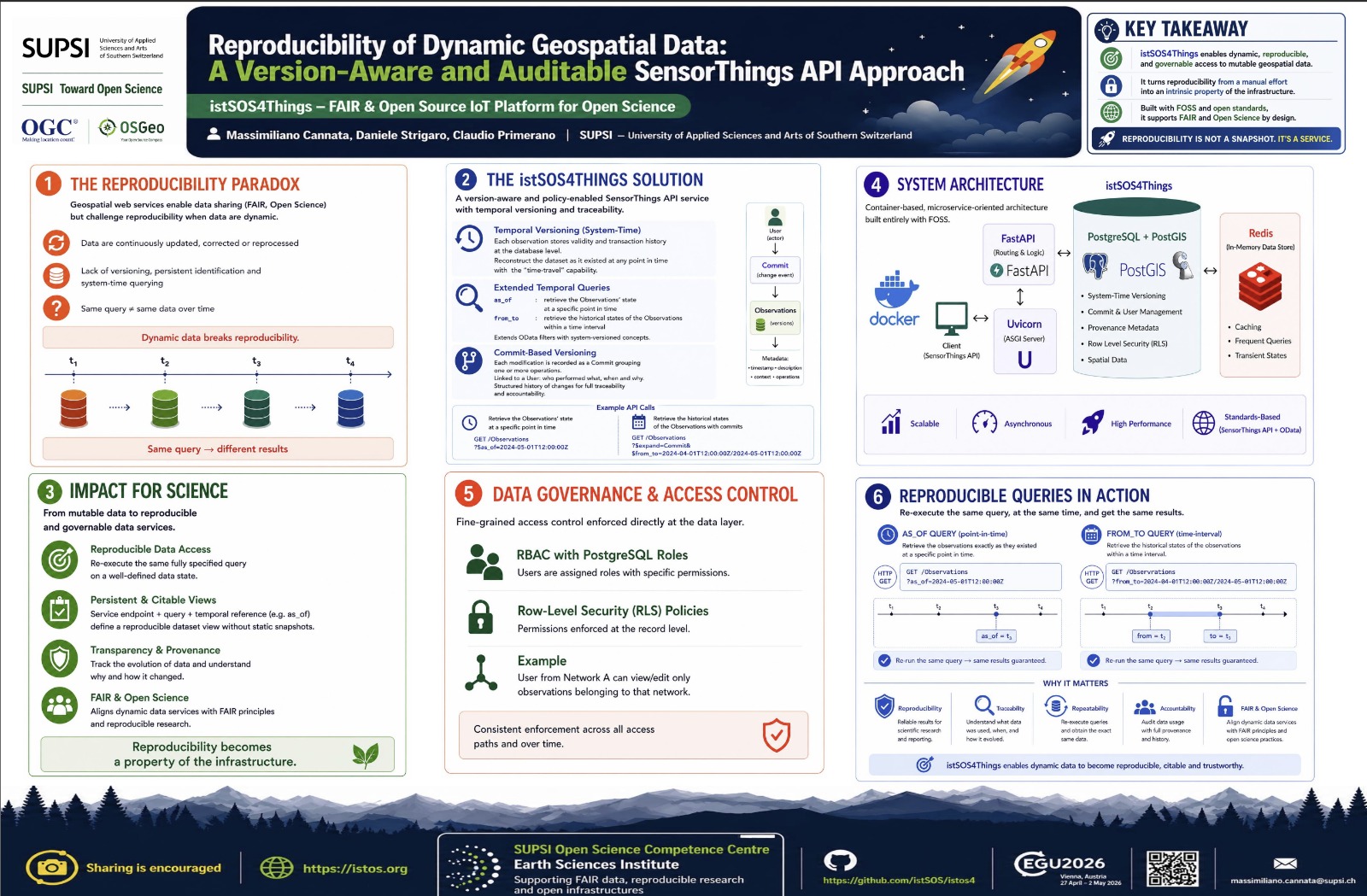
Temporal queries play a crucial role not only for data management, but also for the broader principles of Open Science and scientific reproducibility. In many scientific workflows, datasets, metadata, sensor configurations, and processing parameters evolve continuously over time. Without a mechanism to preserve and reconstruct these changes, reproducing past analyses becomes extremely difficult, if not impossible.
In the context of Web services of environmental monitoring data, temporal queries become particularly relevant. Observations, sensor metadata, procedures, or even station configurations may change over time, and understanding when and why those changes occurred is often as important as the data itself. For example, a sensor calibration update, a correction of metadata, or the replacement of an observation procedure can significantly influence the interpretation of historical measurements.
Additionally, in the age of AI and dynamic data services, temporal queries become essential to ensure transparency, reproducibility, and trust. They allow users and algorithms to retrieve the exact state of data at a specific point in time, preventing ambiguity caused by continuously evolving information sources.
In this sense, a temporal query acts similarly to an immutable reference or a DOI for a dataset: instead of pointing only to “the latest version,” it provides access to the precise historical state that was used for an analysis, experiment, or AI model execution. This also reduces the need to continuously create and preserve static snapshots of datasets solely for reproducibility purposes, since the historical state can be reconstructed directly from the service itself.